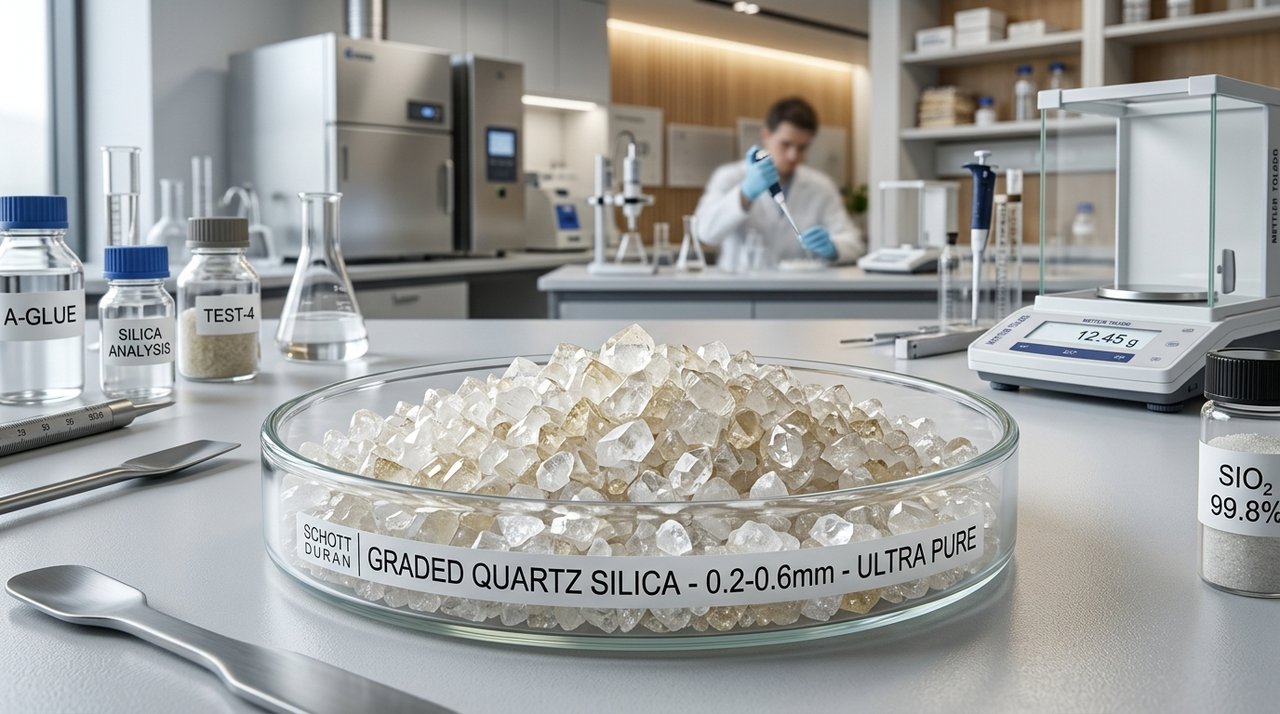
Our Absolute Quality Commitment
At Gressbond Adhichem (Himatnagar, Gujarat), we maintain a strict standard: every single product manufactured under the Gressbond® brand is 100% silica-based. We maintain an absolute zero-tolerance policy against inferior or unverified aggregates. River sand is never used, nor is fly ash used in even a single formulation across our entire product line. We engineer our adhesive and AAC block-jointing solutions exclusively with high-purity graded quartz silica to deliver unmatched structural durability and adhesion.
Why We Reject River Sand (4 Critical Drawbacks)
Ordinary river sand is frequently used in unorganized mortar mixing due to its low initial procurement cost. However, in modern tile adhesives and precision block-jointing formulations, river sand introduces critical structural vulnerabilities:
High Impurities & Silt Content
Natural riverbeds carry organic silt, clay particles, and microscopic mud residues. These impurities coat cement crystals, preventing proper hydration and severely weakening the cementitious adhesive matrix.
Inconsistent Particle Grading
Natural river sand exhibits erratic particle size distribution. Irregular particle packing results in microscopic voids, causing unpredictable drying shrinkage, stress cracks, and hollow debonding under tiles.
High Water Absorption
Clay and silt in river sand absorb excessive mixing water. This deprives the polymers and cement crystals of the precise water needed for hydration, negatively impacting workability, curing, and final tensile set strength.
Severe Environmental Depletion
Unregulated river dredging damages natural ecosystems, erodes riverbanks, and disrupts groundwater tables. Gressbond supports sustainable and controlled mineral processing rather than natural habitat destruction.
Why We Reject Fly Ash (4 Critical Drawbacks)
While industrial thermal power plant fly ash is widely utilized as a low-cost volume filler in generic pre-mixes, its inclusion in high-performance tile adhesives compromises early bonding strength and surface aesthetics:
Slow Early Strength Development
Fly ash relies on sluggish secondary pozzolanic reactions. It significantly delays early mechanical bond strength and structural load-bearing capacity, creating slippage risks on vertical walls and delaying traffic readiness.
Chemical Variability & Unburned Carbon
Because fly ash is an industrial byproduct, its chemical composition fluctuates wildly from boiler to boiler. Unburned carbon particles absorb chemical additives unevenly, causing uncontrollable batch-to-batch variations.
Severe Efflorescence Risk
Fly ash contains high concentrations of leachable soluble salts and free alkalis. Over time, moisture causes these salts to migrate to tile surfaces and grout joints, forming unsightly white chalky stains (efflorescence).
Weathering Susceptibility
Fly-ash-filled mortars exhibit lower long-term resistance to aggressive environmental moisture, freeze-thaw cycles, and chemical carbonation attacks, causing gradual micro-porosity and joint degradation.
The Gressbond 100% Pure Silica Standard
To guarantee industrial-grade adhesion and peace of mind for architects, builders, and tile applicators, Gressbond Adhichem utilizes high-purity, washed, and rigorously graded quartz silica. Here is why pure silica formulation outperforms any alternative:
Controlled Particle Morphology & Maximum Mechanical Interlock
Our silica is mechanically graded into micro-fine and coarse fractions. The sharp, angular quartz grains achieve optimal bulk packing density, eliminating internal voids and interlocking mechanically with cement polymers for extreme grip.
Zero Deleterious Impurities & Chemical Inertness
Pure quartz silica (SiO₂) is completely chemically inert. It contains zero organic silt, zero clay, and zero soluble salts. This ensures zero risk of efflorescence or unwanted alkaline chemical degradation over the decades.
Superior Tensile & Shear Bond Strength
By providing an ultra-dense, stable quartz skeleton, our formulation delivers exceptional tensile and shear adhesion values that far exceed standard requirements under heavy thermal expansion, vibrations, and wet conditions.
Consistent Batch-to-Batch Uniformity
Factory-controlled silica screening guarantees that every bag of Gressbond tile adhesive behaves identically on site. Applicators enjoy predictable open time, consistent water demand, and flawless trowel workability every time.
Material Comparison at a Glance
| Key Technical Parameter | Gressbond 100% Pure Silica | Ordinary River Sand | Industrial Fly Ash |
|---|---|---|---|
| Bond Strength & Adhesion | Superior & Consistent | Unpredictable / Weak Matrix | Sluggish Early Strength |
| Clay, Silt & Impurities | 0% (Pure Washed Quartz) | High Organic Silt & Clay | Carbon & Heavy Oxide Residues |
| Efflorescence (White Staining) | Zero Risk (Chemically Inert) | Moderate to High | Very High Leachable Salts |
| Particle Packing Density | Dense Angular Interlock | Erratic Void Spaces | Spherical / Low Interlock |
| Environmental Sustainability | Controlled Sustainable Processing | Ecological Riverbed Destruction | Thermal Waste By-Product |
Demand The Pure Silica Advantage For Your Project
Whether you are constructing high-rise residential towers, commercial facades, or luxury villas, choose Gressbond's certified 100% pure silica adhesives for zero-failure tile installation.