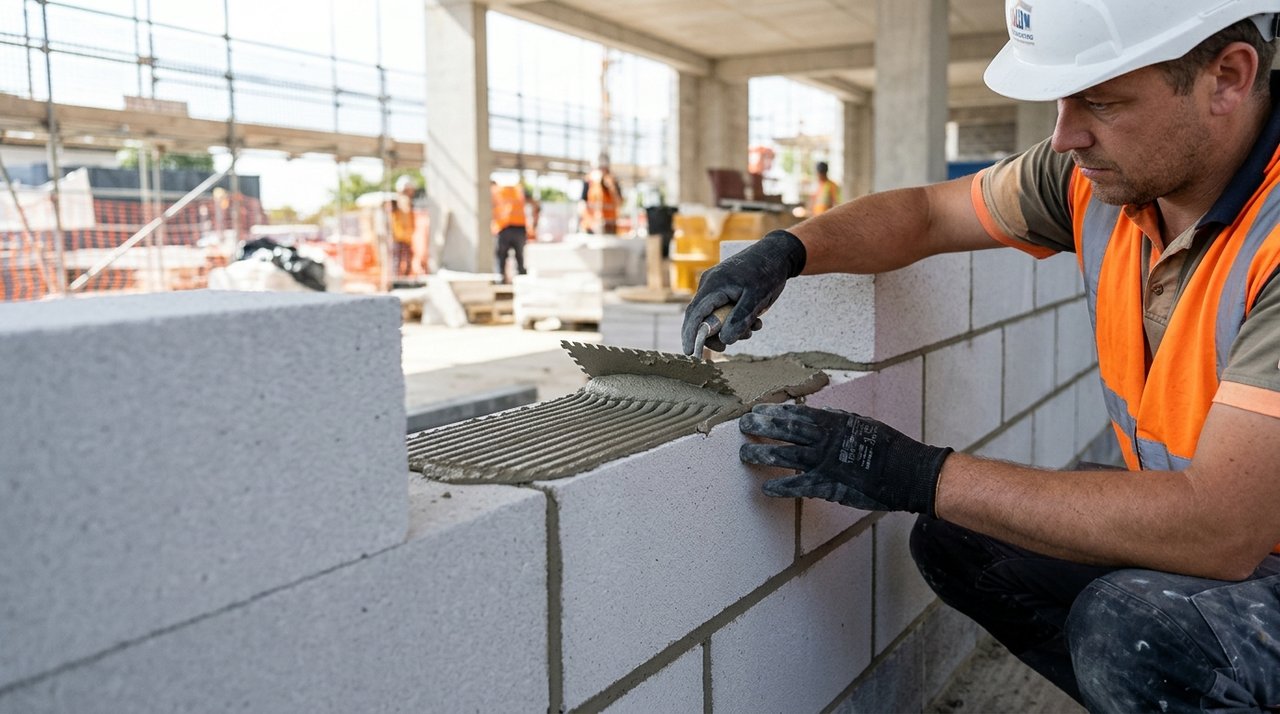
In modern residential, commercial, and high-rise construction, Autoclaved Aerated Concrete (AAC) blocks have largely superseded traditional red clay bricks. Architects, builders, and homeowners prefer AAC blocks because they are lightweight, eco-friendly, dimensionally uniform, offer outstanding thermal and acoustic insulation, and drastically accelerate erection speeds.
However, many construction sites commit a critical engineering mistake: they invest in high-tech AAC blocks but join them using outdated, thick river-sand and cement mortar.
Using a thick 15mm layer of conventional sand-cement mortar completely compromises the thermal efficiency and dimensional accuracy of AAC blocks. Here is why traditional mortar fails, and how switching to thin-bed block jointing mortar delivers monolithic, crack-free walls.
Why Traditional Sand-Cement Mortar Fails with AAC Blocks
Moisture Absorption & Weak Bonding
AAC blocks have a porous, cellular matrix that rapidly draws mixing water out of conventional wet cement mortar. Because water is sucked away before the cement crystals can properly hydrate, the joint cures into a brittle, chalky powder with poor shear and tensile adhesion.
Joint Shrinkage & Hairline Wall Cracks
Traditional mortar is applied in thick beds of 12 mm to 18 mm. As this massive volume of water evaporates during curing, the mortar shrinks heavily, triggering vertical and horizontal step-cracks across masonry and finished wall plaster.
Thermal Bridging (Heat Leakage)
AAC blocks are designed to keep buildings cool by providing thermal resistance. However, thick 15mm dense sand-cement joints act as thermal bridges that conduct blazing outside heat directly into interior spaces, slashing energy savings.
High Material Wastage & Uneven Plumb
Unwashed river sand contains silt, mud balls, and gravel pebbles that force masons to lay uneven beds. During application, up to 20% to 25% of conventional mortar falls to the floor as dead waste.
The Modern Solution: Gressbond 555 Blockadd (Thin-Bed Technology)
Specially formulated polymer-modified Block Jointing Mortar (like Gressbond 555 Blockadd) is engineered specifically for AAC blocks, cellular concrete, and fly-ash bricks. Instead of an unmanageable 15mm thick layer, it is applied in a calibrated 6 mm to 10 mm bed.
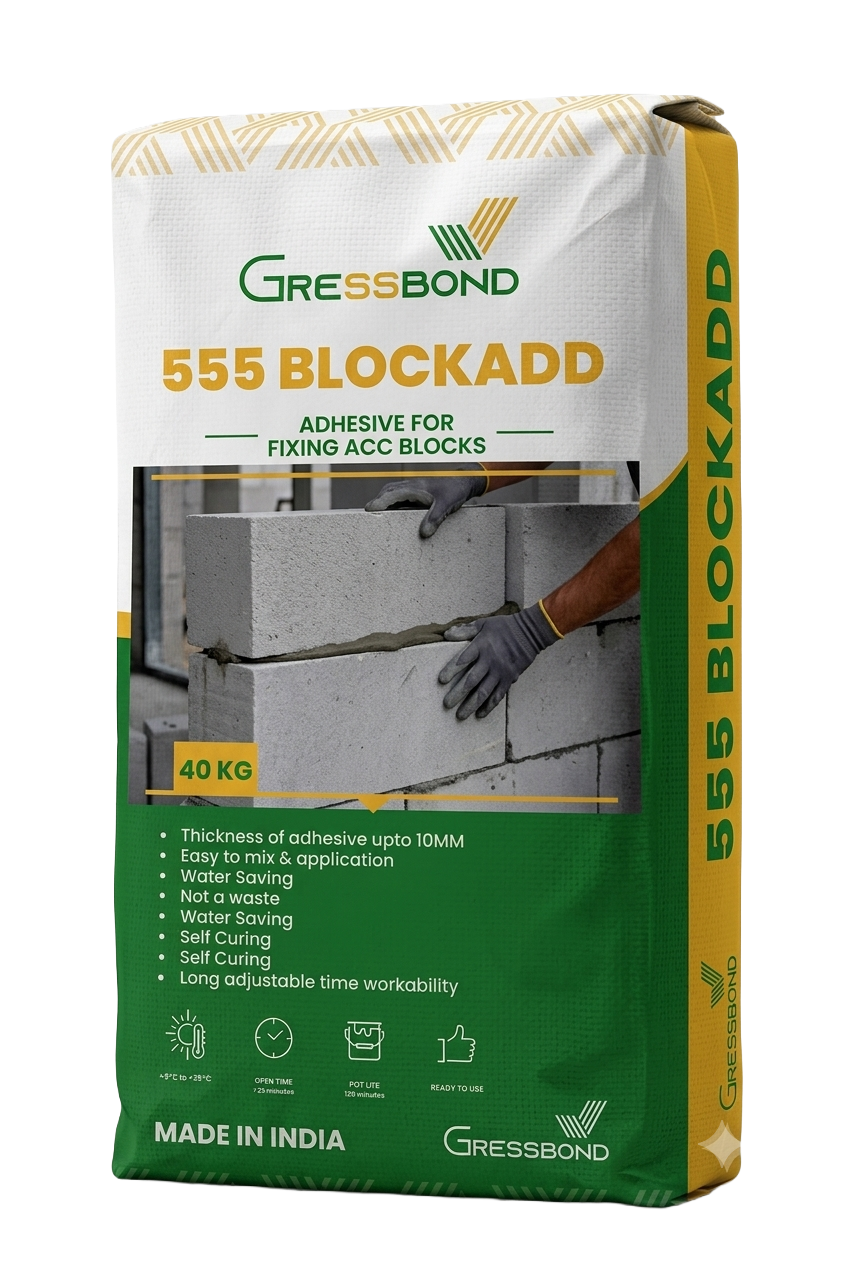
Gressbond 555 Blockadd
High-strength polymer-modified thin-bed mortar engineered exclusively for joining AAC blocks. Formulated with 100% pure graded silica and chemical polymers, delivering zero shrinkage, extreme shear bond strength, and total elimination of water curing.
100% Pure Graded Silica (Zero River Sand & Zero Fly Ash)
Unlike local unwashed river sand or fly ash mixes, Gressbond 555 Blockadd uses precision-screened pure quartz silica. This ensures uniform density, zero silt impurities, and a smooth, lump-free paste that trowels effortlessly at 6-10 mm bed thickness.
Zero Water Curing Required (Self-Curing Polymers)
Advanced water-retention polymers lock moisture inside the 6-10 mm joint so the mortar cures chemically from within. This eliminates the need for 7 to 10 days of post-construction water curing—saving tens of thousands of liters of potable water on-site.
Certified High Shear & Tensile Strength
Tested to IS 15477 methodology, 555 Blockadd achieves exceptional Shear Adhesion (2.40 N/mm²) and Tensile Adhesion (2.30 N/mm² in dry condition), creating a monolithic wall structure ready for subsequent trades in 24 hours.
Extended Workability & 3x Faster Construction
A generous 45-minute open time and 60-minute pot life allow masons to apply continuous mortar beds and align blocks with laser-straight plumb, working up to 3 times faster than manual sand-cement mixing.
Substantial Savings on Plastering & Gypsum Punning
Because 6-10 mm uniform joint lines keep the wall perfectly plumb and flush, internal walls require only a thin coat of plaster or direct gypsum punning—saving significant material, labor, and dead-load weight.
Head-to-Head: Gressbond 555 Blockadd vs. Traditional Mortar
| Parameter | Gressbond 555 Blockadd | Traditional Sand-Cement Mortar |
|---|---|---|
| Joint Bed Thickness | 6 mm to 10 mm (Bed Thickness) | 12 mm to 18 mm (Thick-Bed) |
| Raw Material Base | 100% Pure Graded Silica & Polymers | Unwashed River Sand & Cement (High Silt) |
| Water Curing | Zero Curing Required (Self-Curing) | 7 to 10 days of heavy water curing required |
| Bonding Strength | High Chemical & Mechanical (2.30 N/mm² Tensile) | Weak mechanical bond; prone to shrinkage cracks |
| Construction Speed | 3x Faster; ready for plaster in 24-48 hrs | Slow; must wait days for curing before plastering |
| Material Consumption | Minimal (1 bag covers significantly more area) | High volume (5x to 6x more mortar required) |
| Site Cleanliness & Wastage | Neat, premixed, zero dust, negligible waste (<2%) | Messy storage, manual sieving, 20%+ floor wastage |
Step-by-Step: How to Apply Block Jointing Mortar Properly
Clean the Blocks
Brush off any loose dust, saw debris, or mud residues from the top and vertical faces of the AAC blocks. In hot or dry weather, lightly dampen the contact surfaces with water to prevent sudden temperature shock.
Mix in the Right Ratio
Gradually add the dry 40 KG powder into clean water according to the specified 22.50% water demand (approx. 9 liters per 40kg bag). Mix mechanically for 3–5 minutes until a smooth, lump-free paste forms. Allow 5 minutes slaking, remix, and apply.
Spread with a Notched Trowel
Using a dedicated block-laying notched trowel matching the width of your AAC block, spread a continuous, uniform 6 mm to 10 mm layer along the horizontal mortar bed and vertical side joints.
Place, Tap & Level
Position the AAC block firmly onto the combed mortar bed. Tap gently with a rubber mallet in both directions to seat the block, collapse mortar ridges, and align it perfectly plumb. Scrape off any excess squeezed-out mortar immediately.
Upgrade Your Masonry with Gressbond 555 Blockadd
Building with AAC blocks is a smart step toward modern energy efficiency. Ensure certified shear strength, crack prevention, and zero water curing with Gressbond 100% pure silica block adhesive.